
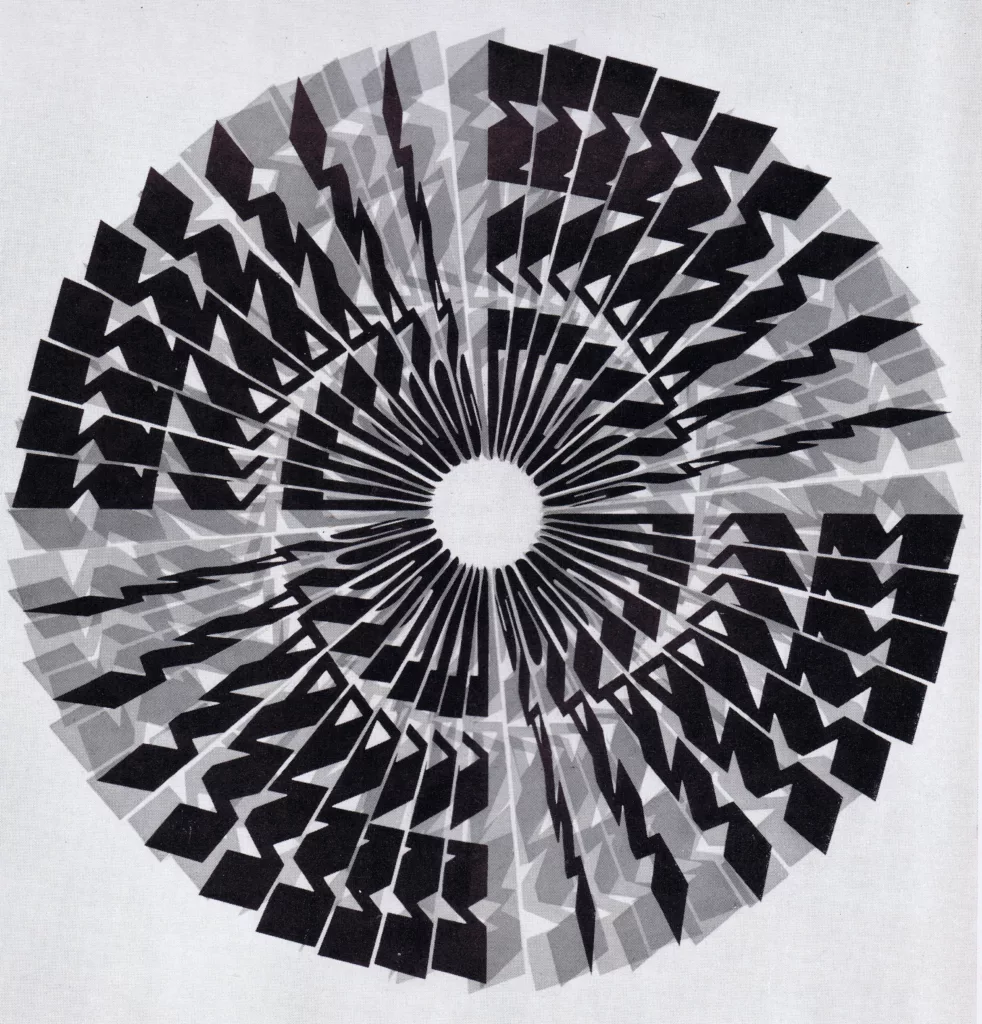
Constructive Posters – Bauhaus to Swiss Style, Tama Art University, 2001

Content includes:
Chronological trends in constructive art and graphic design / Koji Fukakusa
Constructive Poster / Koji Fukakusa
Origin of Swiss style 1925-1935 / Richard Hollis
Josef Müller-Brockmann’s modeling idea / Shizuko Yoshikawa
Attribute and attribute diagram of structured poster / Koji Fukakusa
Attribute diagram vocabulary
Designer research and analysis
Swiss modeling method / Shiro Habara
What is the Basel school / Hitoshi Koizumi
Sans-serif in a structured poster / Go Maruyama
Structure of the modeling process / Koji Fukakusa
Semiotic consideration of posters / Elisabeth Walter
Semiotics of Perth and Morris / Tadashi Matsuda
Modern posters seen from printing and paper / Kunio Kobayashi, Keiichi Nakano, Takao Kawai
Basics of concrete painting / Karlsund, Dooseburg, Elyon, Tutandian, Van Doesburg
Annotation about the basics of concrete painting / Theo van Doesburg
Concrete modeling / Max Bill
Untitled (What is Gutai Art Association) / Max Bill
One view / Max Bill
Mathematical method in contemporary art / Max Bill
Abstraction / composition in Germany / Eckhard Neumann
Josef Müller-Brockmann, a pioneer of structural and in-kind design in Europe in the 20’s and 30’s
Constructive poster / Josef Müller-Brockmann
Poster design law / Josef Müller-Brockmann
New typography / Laszlo Moholy-Nagy
Typo Photo / Laszlo Moholy-Nagi
Basics of typography / Jan Tschichold
Photography and typography / Jan Tschichold
Typography and promotional material modeling / Herbert Bayer
Grid system Its function and deployment / Josef Müller-Brockmann
Literature / Wani Yoshitaka, Senjinji, Roger Bernard
Formation of Takeo Poster Collection / Robert K. Brown

Details

  • Format Book
  • Year 2001
  • Client/Publisher Central Public Theory Art Publishing
  • Size 217mm x 302mm

Linked Information

Constructive Posters - Bauhaus to Swiss Style, Tama Art University, 2001
Constructive Posters – Bauhaus to Swiss Style, Tama Art University, 2001


Constructive Posters - Bauhaus to Swiss Style, Tama Art University, 2001
Constructive Posters – Bauhaus to Swiss Style, Tama Art University, 2001


Constructive Posters - Bauhaus to Swiss Style, Tama Art University, 2001
Constructive Posters – Bauhaus to Swiss Style, Tama Art University, 2001


Constructive Posters - Bauhaus to Swiss Style, Tama Art University, 2001
Constructive Posters – Bauhaus to Swiss Style, Tama Art University, 2001


Constructive Posters - Bauhaus to Swiss Style, Tama Art University, 2001
Constructive Posters – Bauhaus to Swiss Style, Tama Art University, 2001
Constructive Posters - Bauhaus to Swiss Style, Tama Art University, 2001
Constructive Posters – Bauhaus to Swiss Style, Tama Art University, 2001
More graphic design artefacts
More graphic design history articles
Guillermo Gonzalez Ruiz by Sigwart Blum, 1964

Design Archive Feature, Designer Profiles, Members Only Content, Regional Histories

Guillermo Gonzalez Ruiz by Sigwart Blum, 1964

A few years ago the publicity department of Siam di Tella found a collaborator who early in his studies of architecture was attracted by the problems of visual art. His name is Guillermo González Ruiz he was born in Chascomus (Province of Buenos Aires) in 1937. Between 1957 and 1960 he received 18 awards in poster competitions, some of which were of particular importance.

Read Article
The New Illustrated Library of Science and Invention designed by Erik Nitsche

Design Archive Feature, Members Only Content

The New Illustrated Library of Science and Invention designed by Erik Nitsche

Erik Nitsche's notable book series, the New Illustrated Library of Science and Invention comprised twelve volumes and they are a fantastic example of how to design a perfect non-fiction book!

Read Article
A Collection of Japanese Ephemera from the 1930s and 1940s

Design Archive Feature, Ephemera, Members Only Content, Regional Histories

A Collection of Japanese Ephemera from the 1930s and 1940s

Beyond being mere artefacts of design, these examples of Japanese Ephemera show the dynamic changes Japan was undergoing during this period. The design output of this era not only served commercial purposes but also became a powerful medium for expressing these societal shifts.

Read Article