

Total DesignWim Crouwel

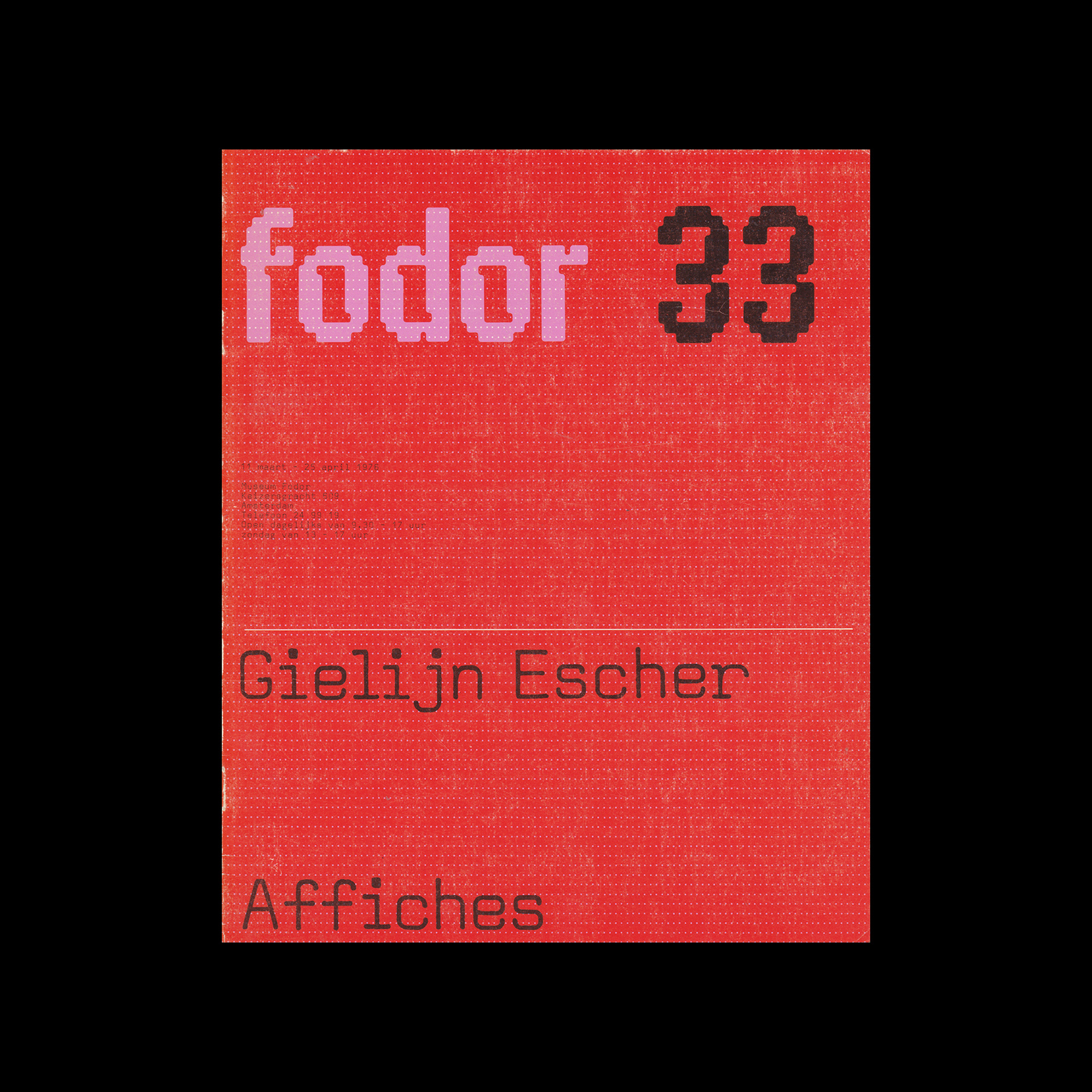
Fodor 33, 1976 – Gielijn Escher, Affiches

Details

  • Format Exhibition Catalogue
  • Designer/s Wim Crouwel and Daphne Duijvelshoff (Total Design)
  • Year 1976
  • Size 200mm x 250mm
Wim Crouwel and Daphne Duijvelshoff (Total Design)
Daphne van Peski (Duijvelshoff) was born in 1942. She was a designer at Total Design and designed many Stedelijk Museum catalogues with Wim Crouwel. Daphne was also a member of the GVN, the Dutch association of graphic designers. Explore related designers including Wim Crouwel and Jolijn van de Wouw. See also Total Design and Dutch Modernism.
Total Design was founded in Amsterdam in 1963 by Wim Crouwel, Friso Kramer, Benno Wissing, and Paul and Dick Schwarz and was the first large-scale multidisciplinary design consultancy in the Netherlands. Under Crouwel's creative direction the studio developed a rigorous systematic approach rooted in grid systems and neutral typography. Its long-running relationship with the Stedelijk Museum Amsterdam produced catalogues, posters, and exhibition graphics that remain among the most influential bodies of institutional design in postwar Europe. Other major clients included the Dutch Post Office and Schiphol airport. The practice continues today as Total Identity. Explore designers associated with Total Design including Wim Crouwel, Jurriaan Schrofer, and Benno Wissing. See also Dutch Modernism, Dutch graphic design history, and 1960s graphic design history.
Willem Hendrik Crouwel was born in 1928 in Groningen, Netherlands. He studied at the Academy of Arts and Crafts in Groningen and took evening classes at the Institute of Arts and Crafts, now the Rietveld Academy. His teacher, Charles Jongejans, was trained by notable Dutch designers Paul Schuitema and Gerard Kiljan. In 1952, Crouwel began his design career at Enderberg, designing exhibitions and trade stands, gaining valuable experience. After leaving Enderberg in 1956, he founded a studio with industrial designer Kho Liang Ie, working on various projects across design disciplines, including graphic and exhibition design. Influenced by mid-century Swiss typography, Crouwel explored letterforms and graphic systems, using fonts like Helvetica and Univers. His early clients included the Van Abbe Museum, where he designed catalogues and posters. In 1963, he co-founded the influential design agency Total Design and also started working for the Stedelijk Museum, collaborating with Edy de Wilde until 1986. Explore the Design Reviewed archive to discover artefacts connected to Wim Crouwel. The Dutch Modernism movement, the Netherlands and the 1960s and 1970s decade pages.
Fodor
Fodor was a Dutch exhibition catalogue series designed by Wim Crouwel. They were a total of 40 issues published, each following Crouwel's design system.

Linked Information

Fodor 33, 1976 - Gielijn Escher, Affiches. Designed by Wim Crouwel and Daphne Duijvelshoff (Total Design)
Fodor 33, 1976 – Gielijn Escher, Affiches. Designed by Wim Crouwel and Daphne Duijvelshoff (Total Design)
More graphic design artefacts
More graphic design history articles
The selected poster designs for the Swiss Posters of 1960 award

Design Archive Feature, Members Only Content, Poster Design, Regional Histories

The selected poster designs for the Swiss Posters of 1960 award

The Best Swiss Posters Award was an annual competition, judged by a Swiss Jury. They selected a range of posters, showcasing a range of poster styles from completely typographic designs such as the work of Robert Büchler, to the illustrated posters of Donald Brun.

Read Article
Atelier Theo Häussler – Designing for the Pharmaceutical Industry by Carl Heussner, 1963

Advertising Design, Design Archive Feature

Atelier Theo Häussler – Designing for the Pharmaceutical Industry by Carl Heussner, 1963

Theo Häussler's commercial art is distinguished by its clear and disciplined form and its distinct advertising message.

Read Article
To Have and To Hold: A visual collection of paper bag ephemera from a bygone era

Book Reviews & Press Releases

To Have and To Hold: A visual collection of paper bag ephemera from a bygone era

To Have and To Hold, contains hundreds of bag designs collected during over half a century. The book is a must-buy for anyone interested in ephemera, the history of design or British high street history.

Read Article