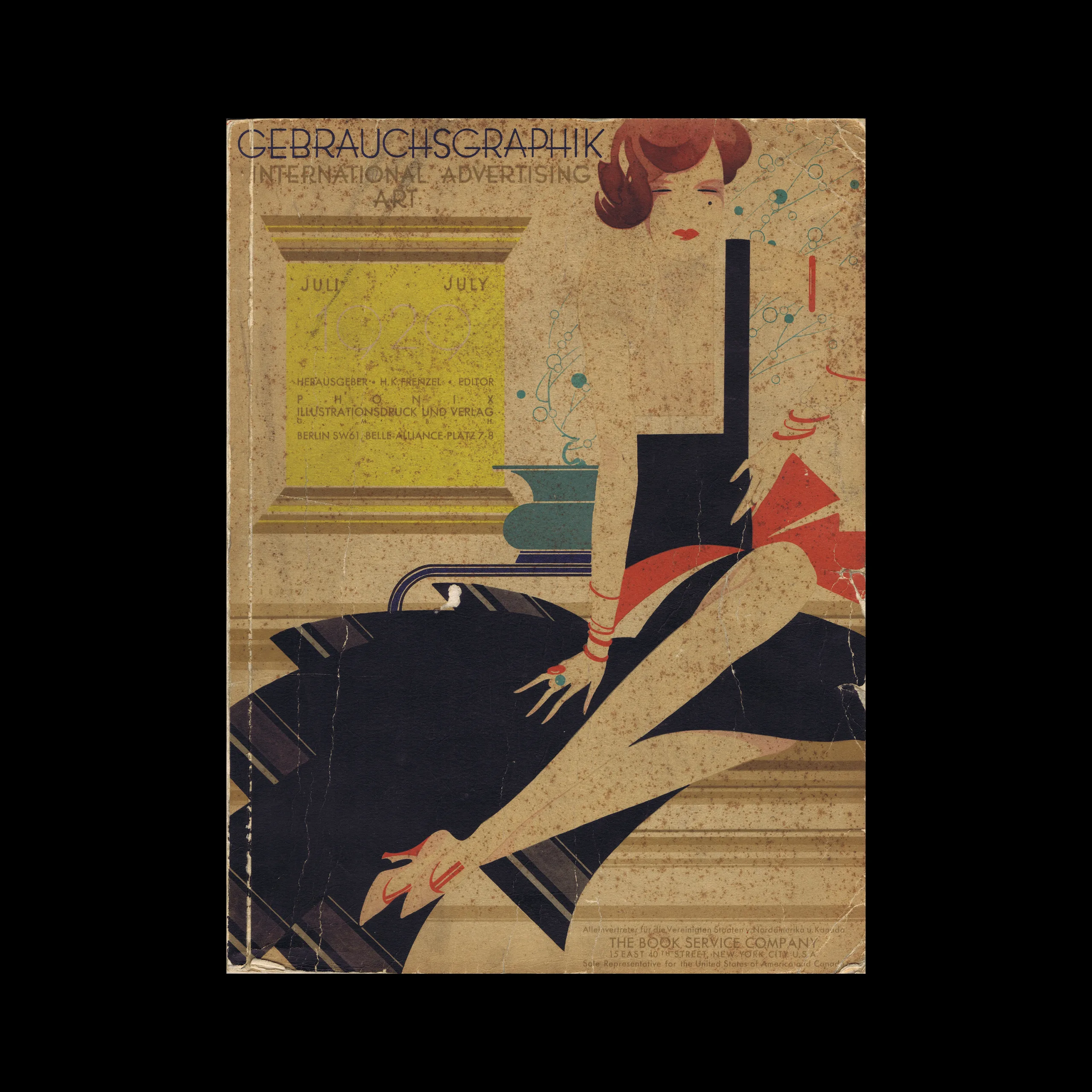

Gebrauchsgraphik, 07, 1929

Selected Contents: dvertising Exhibition and International Advertising Convention Berlin 1929; Dryden-Paris; Commercial Art in Austria; Review of Newest French and German Posters; Fred Hendriok

Selected Artists: Otto Arpke, Joseph Binder, A. M. Cassandre, Dryden, Rolf Frey (Trias), Franz Paul Glass, Fred Hendriok, Heinrich Jost, Max Körner, Julius Kupfer-Sachs, Otto Kutscher, Robert L. Leonard, Max Liebermann, Gerhard Marggraff, Louis Oppenheim, Willy Petzold, Hartmuth Pfeil, Walter Riemer, Hans Schleger (Zero), Harald Schwerdtfeger, Bernd Steiner, Julius Steiner, Valentin Zietara

Details

Jupp Wiertz
Gebrauchsgraphik
A German design magazine published from 1924 onwards, devoted to commercial art and advertising design.

Linked Information

Gebrauchsgraphik, 07, 1929. Cover design by Jupp Wiertz
More graphic design artefacts
More graphic design history articles
New book to focus on Norwich’s medieval logos

Book Reviews & Press Releases

New book to focus on Norwich’s medieval logos

The stories of Norwich’s medieval merchants’ marks is being told in a new book and exhibition.

Read Article
Japanese Modernism

Design Archive Feature, Members Only Content, Movements, Regional Histories

Japanese Modernism

Japanese modern design was heavily influenced by European art movements, particularly modernism and the Bauhaus school. As Japan's advertising industry expanded, it increasingly drew from Western culture, especially television and film, resulting in designs that were eclectic, vibrant, and infused with modernist energy.

Read Article
Rational Simplicity, the first major monograph of Rudolph de Harak by Richard Poulin

Uncategorized

Rational Simplicity, the first major monograph of Rudolph de Harak by Richard Poulin

"Rudy is one of the unsung pioneers of American mid-century modernist graphic design. He had a unique and definitive point of view that was really never celebrated. This may have been attributed to his strict adherence to the formal principles of modernism and the International Typographic Style."

Read Article