
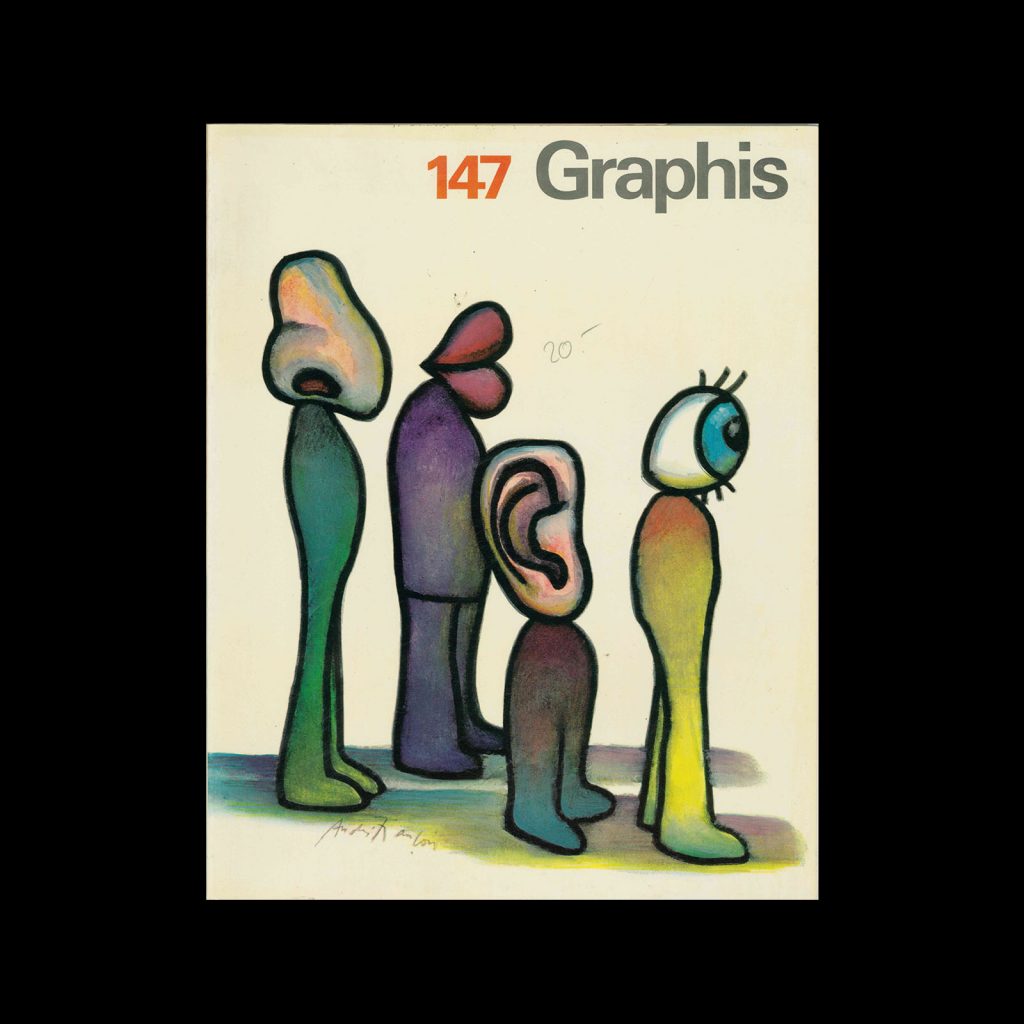
André François

Society of Industrial Artists, 53, October/December 1956

Details

André François
André François was born on November 9, 1915, and attended the Académie des Beaux-Arts in 1933 and the Ecole de Cassandre in Paris in 1934-35. His work includes posters, illustrations, stage design, and sculpture. Explore related designers including Jean Colin and Raymond Savignac. See also French graphic design history and 1950s graphic design history.
Society of Industrial Artists
The Society of Industrial Artists journal documented the work and professional concerns of Britain's leading industrial and graphic designers from the mid-twentieth century.

Linked Information

Society of Industrial Artists, 53, October/December 1956
Society of Industrial Artists, 53, October/December 1956. Cover design by André François,
More graphic design artefacts
More graphic design history articles
Erberto Carboni and his work for Radio Italiana, 1940s and 1950s

Advertising Design, Design Archive Feature, Members Only Content, Regional Histories

Erberto Carboni and his work for Radio Italiana, 1940s and 1950s

These one-colour forms have a playful but structured aesthetic through their geometric forms, they remind me of the abstract line drawings of Picasso blended with Jan Tschichold and the New Typography.

Read Article
The Central School of Arts and Crafts (Modernist Graphic Design in Britain 1945–1980)

Design Archive Feature

The Central School of Arts and Crafts (Modernist Graphic Design in Britain 1945–1980)

The Central School of Arts and Crafts, featured in Modernist Graphic Design in Britain 1945–1980 by Ian McLaren and Tony Pritchard.

Read Article
A New Visual Language: From New Wave to Postmodernism in Graphic Design

Design Archive Feature, Members Only Content, Movements

A New Visual Language: From New Wave to Postmodernism in Graphic Design

A 1,500 essay on the transformative era of graphic design from the 1970s to the 1990s. Moving beyond the constraints of modernism, designers like Wolfgang Weingart and April Greiman redefined visual communication through bold experimentation with type, colour, and early computer graphics. This essay highlights how postmodernism and New Wave design introduced complexity, individuality, and digital innovation in to graphic design.

Read Article