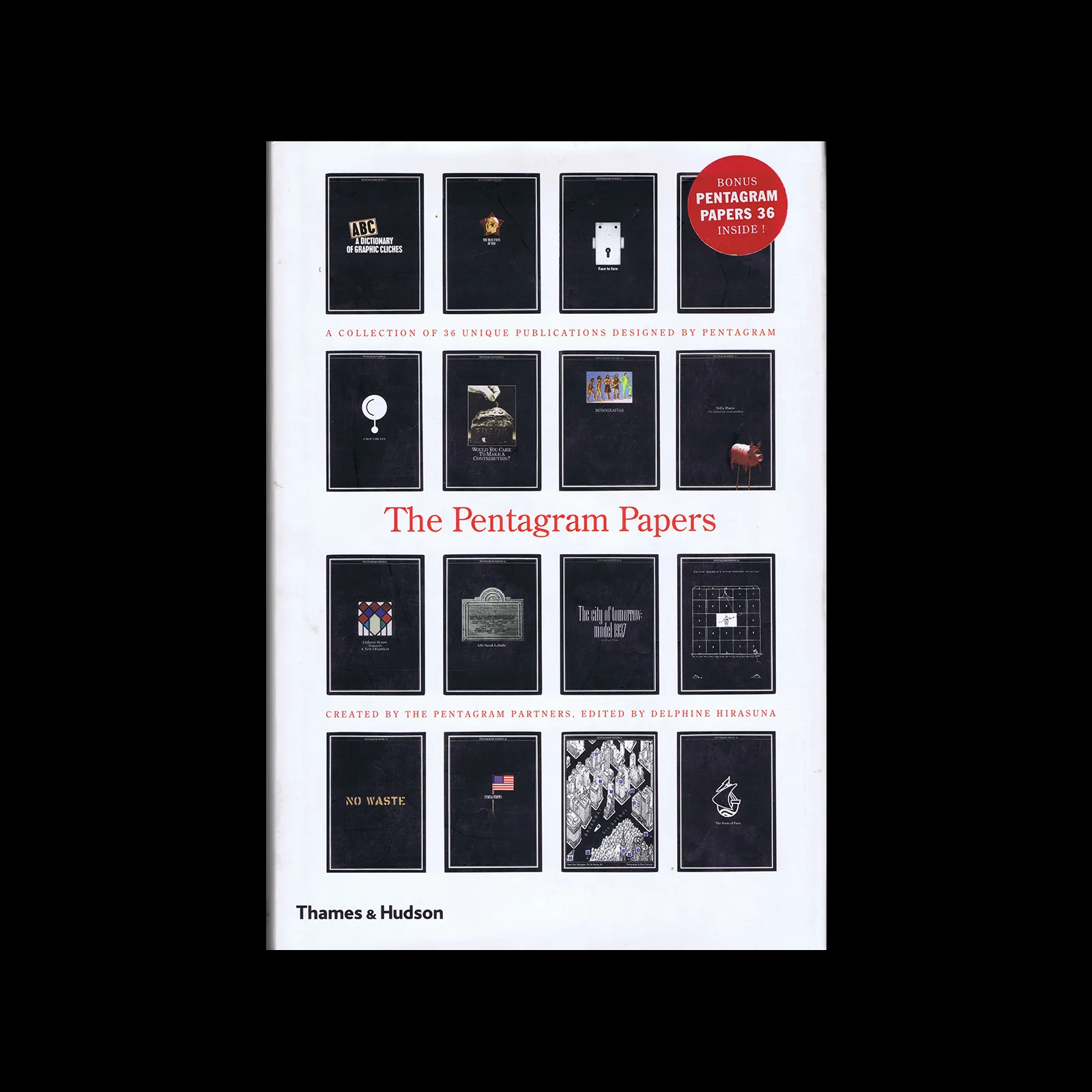

The Pentagram Papers: A collection of 36 unique publications, Thames & Hudson, 2006

(Preface) ‘The Pentagram papers : a collection of thirty-six papers containing curious, entertaining, stimulating, provocative, and occasionally controversial points of view that have come to the attention of, or in some cases are actually originated by the partners of Pentagram Design.’

Details

  • Format Book
  • Designer/s Pentagram
  • Year 2006
  • Client/Publisher Thames & Hudson
  • Size 210mm x 310mm
Pentagram
Pentagram is one of the world’s leading independent design studios. It was founded in 1972, by Alan Fletcher, Theo Crosby, Colin Forbes, Kenneth Grange, and Mervyn Kurlansky. Explore related designers including Alan Fletcher, Colin Forbes, and Bob Gill. See also British Modernism and Rise of Corporate Identity.

Linked Information

The Pentagram Papers: A collection of 36 unique publications, Thames & Hudson, 2006
More graphic design artefacts
More graphic design history articles
The Danish Film Institute’s collection of Cuban Film Posters

Regional Histories

The Danish Film Institute’s collection of Cuban Film Posters

The Cuban film poster conveys the spirit and ideals of the Cuban revolution. A time of political change, an uprising that ended the brutal dictatorship of Fulgencio Batista. The Danish Film Institute have a collection of Cuban Film Posters from the past 50 years.

Read Article

Euro Deco. European Art Deco Graphic Design

Movements, Advertising Design, Design Archive Feature, Members Only Content

Euro Deco. European Art Deco Graphic Design

Art Deco graphic design history: its Paris origins, key pioneers Cassandre, Carlu and McKnight Kauffer, and how the style evolved across Britain, Germany, Italy, Spain and the US.

Read Article
Bauhaus Principles Today

Design Archive Feature, Design Education, Members Only Content, Movements

Bauhaus Principles Today

The Bauhaus approach to design emphasised simplicity, functionality, and the integration of modern technologies and materials. A century later, many of the principles taught at the school remain fundamental to contemporary design practices.

Read Article