
Kazumasa Nagai, Japanese Designer

DESIGNER FRIDAY

Kazumasa Nagai, Japanese Designer

Issue: 12
The designer behind Japan’s Olympic emblems and its biggest corporate logos.

Share:

Born: 1929
Nationality: Japanese

Kazumasa Nagai was born in Osaka in 1929 and became one of the key figures in postwar Japanese graphic design. He left the sculpture department at the Tokyo National University of Fine Arts and Music in 1951, before co-founding the Nippon Design Center in 1960.

Nagai gained greater international recognition by designing the official symbols for the 1966 Sapporo Winter Olympics and the 1972 EXPO Okinawa. He also created iconic corporate logos for major companies such as Mitsubishi UFJ, Japan Railways, Nissin, and TEPCO. His vast portfolio includes thousands of posters, many of which have been exhibited in modern art museums worldwide.

Between 1960 and 1988, he received numerous prestigious awards, including the JAAC Award, Asahi Advertising Award, Mainichi Advertising Award, Yamana Award, and multiple accolades from the Tokyo ADC Show.

Design (Japan), 71, 1965. Cover design by Kazumasa Nagai
Design (Japan), 74, 1965. Cover design by Kazumasa Nagai
gq 07 - A Quarterly Review of the Graphic Work, 1974. Cover design by Kazumasa Nagai
gq 03 - A Quarterly Review of the Graphic Work, 1973. Cover design by Kazumasa Nagai
Design (Japan), 73, 1965. Cover design by Kazumasa Nagai
Idea October 1966 Extra issue. Cover design by Kazumasa Nagai.
Kazumasa Nagai

Kazumasa Nagai

Kazumasa Nagai was born in 1929 in Osaka. He left the Tokyo National University of Fine Arts and Music in 1951 and co-founded the Nippon Design Center in 1960. Nagai achieved notable recognition by winning first place in the design competitions for the official symbols of the Sapporo Winter Olympic Games (1966) and EXPO Okinawa (1972). Between 1960 and 1988, he received numerous prestigious awards, including the JAAC Award, Asahi Advertising Award, Mainichi Advertising Award, Yamana Award, and multiple accolades from the Tokyo ADC Show.

Explore related designers including Ikko Tanaka and Yusaku Kamekura. See also Japanese Modernism, Japanese graphic design history, 1960s graphic design history.

More info about Kazumasa Nagai

Related Items from the Archive
More graphic design history articles

Members Content

As part of an ongoing series showcasing Swiss poster designs from the 1950s and 1960s, this article features 1961 poster entries of Die besten Plakate des Jahres (The Best Posters of the Year) 1961. Originating in 1941, Die besten Plakate des Jahres initially served as a platform for the evaluation and showcase of Swiss posters.

Members Content

Karel Martens is one of the most influential Dutch graphic designers, co-founder of the Werkplaats Typografie, working across books, magazines, coins, postage stamps and telephone cards

Members Content

Winter + Bischoff’s work blends fine art and graphic design and is a fine example of commercial design featuring a heavy use of stylistic illustration. In fact a lot of German graphic design in the 1960s has this strong relationship of commercial and professional typographic layout with the roughness and organicness of art.

Members Content

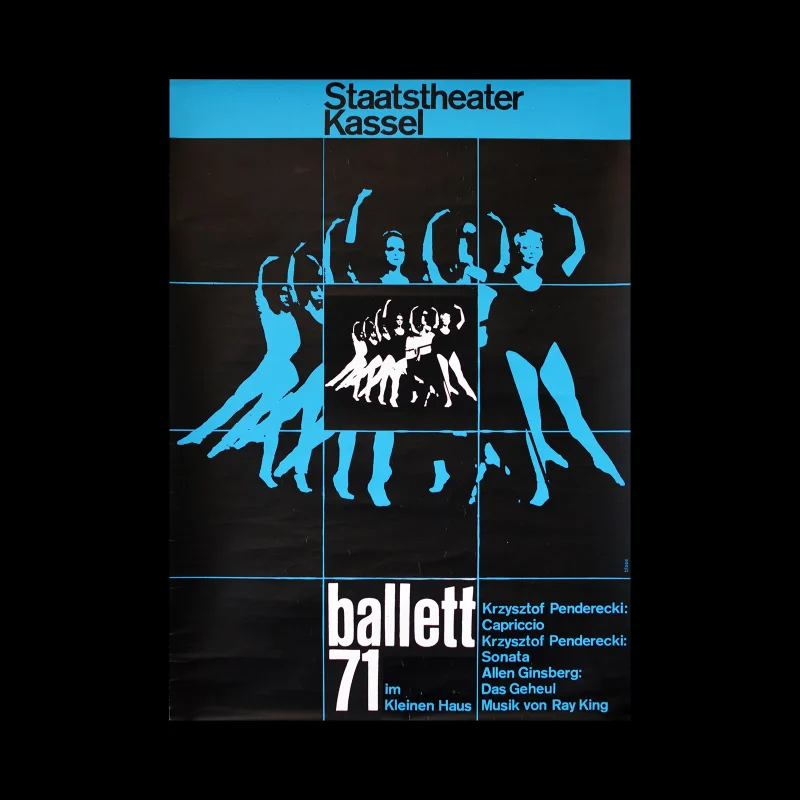
Blase’s long-term clients were Staatstheater Kassel (Kassel State Theater) and Atlas Films. Karl Oskar Blase produced countless posters for these two organisations. It’s not surprising considering Blase designed posters for the Staatstheater for twelve years between 1966 and 1978.